
How to be Visible without the Hype

My project died because I couldn’t advocate for it.
I spent 9 months developing a prototype for a prosthetic arm. I met with the business development lead. Her approval would get me $35K in additional funding and more partnerships. But when I presented the working prototype to her, she didn’t get it.
The project died on the mahogany table.
Even though my design was based on amputee feedback, she couldn’t see the value because I couldn’t speak for it.
If I can’t speak for my work, then who will?
A good idea needs clear messaging. Invisibility kills projects no matter how solid the science.
But we’re not taught to market our ideas as engineers or scientists.
We have a gut reaction that we’re selling like a car salesman. We don’t focus on it because we’re spending 99% of our time on building. But when it comes to the next stage, we stutter because we’re not taught how to be visible.
When we lean into marketing, we overcorrect and hype our project. Overpromising the results and impact.
CRISPR startups did it in 2012 promising revolutionary genetic editing to create any drug for any disease. Theranos promised healthcare shifting results.
Overpromising gets you attention but creates pressure. You’re forced to meet those goals.
The question becomes how do you become visible without the hype?
What NOT to do: The Theranos Playbook
Theranos lied while CRISPR researchers were excited about their discovery and its impacts.
Theranos prevented journalists from looking behind the scenes while the founder, Elizabeth Holmes, performed Steve Jobs cosplay to swoon Silicon Valley Investors.
Theranos promised the moon but delivered sand.
Theranos hijacked the disruption narrative in Silicon Valley to get funding while real healthcare startups dissolved..
If you want to avoid the hype trap, do the opposite of Theranos and you’re 90% on your way.
“If you can get money without hype, you should.”
Ben Reinhardt told me on a call how to be visible in the deep tech industry.
“Messaging is about communicating what you concretely are doing and what your concrete ambitions are, without over-promising”
What separated Theranos and CRISPR’s hype cycles was transparency.
Theranos hid their methods and results, while CRISPR were open with it. The mistake CRISPR made was overpromising too quickly when the CRISPR method had issues to resolve. Investors had Theranos PTSD so they hesitated funding CRISPR startups in 2012.
Until in 2015, Intellia Therapeutics, a CRISPR startup, reframed their pitch:
“We’re advancing in vivo gene editing for specific diseases. Our lead candidates are in clinical trials.”
Same technology. Different story. Easier for investors to fund longer term. In 2016, Intellia raised $108 million in Series B funding led by Atlas Venture, Novartis, and Regeneron.
The gap between you and consistent funding is clear messaging. .
Partnerships and Grants Put You at Someone Else’s Mercy
Partnerships, grant applications, presentations, pitches.
They’re great for networking but they’re slow to get actual visibility. Then there’s the problem of standing out in a sea of 100s of other deep tech founders. Now you’re fighting against the sea of applications and investors have to juggle choosing you over others. Sure, you’re tech might be different, but you’re still 1 drop in an ocean to them.
But worse, you’re at the mercy of someone else’s market & timeline.
Partnerships rely on someone else’s network.
Grants applications rely on someone else’s motivation.
Pitch competitions rely on using someone else’s stage.
You are building on borrowed land using borrowed tools, hoping one day you’d be able to buy your own
Investors Fund People, Not Tech Specs
They focus on marketing for the company but not themselves.
Founder-focused marketing is more powerful than company marketing because there’s a face behind the words. People connect with people rather than companies.
You don’t need to share everything, these 3 types of stories:
Founder Story: How did this company start?
Your Origin Story: Why did YOU start the company?
Customer Success: Who benefits (or will benefit) from your work?
These give investors, clients, and future employees into who you are, what your company does, and why they should care. Everything you need when sharing your story online.
Define the pain, not the market.
Greg Denton from Kwetta, defines the pain Kwetta solves, rather than the market. His posts stay within the energy industry, but he defines the problem as grid congestion, making money while electric vehicles charge, and reducing carbon emissions.
He owns his pipeline by sharing posts about grid congestion problems, not relying on partnerships to bring him clients.
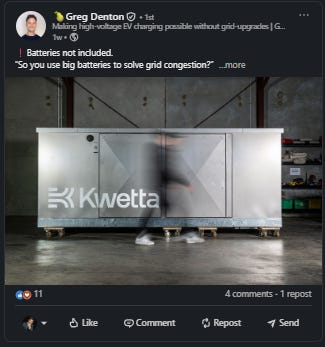
But here’s the key part, he’s not agitating the problem like most marketers do. If you look up common marketing advice, they say to define the problem, agitate it, then give the solution. Often using the imagery of twisting the knife to agitate the problem.
Instead understand the pain and connect with it.
What Greg does in his posts is understand the pain of upgrading the grid to handle more electric vehicles, the pain of power outages, and the expensive pain companies and countries face when their grids get congested. In the Netherlands, grid congestion costs an estimated €40 billion a year.
Instead of defining the market within energy or climate tech, he started with the problem and pain these companies and countries feel when it comes to grid congestion.
Greg owns the pipeline created from his posts. He’s not relying on word-of-mouth marketing or others to market the company.
Funding Follows Evidence, Not Promises
Pre-seed investors don’t care about your 10-year vision. They want to see how you think when things break. Not the technical details, but defining the problem you encountered, what solution you solved.
Investors know the problems are difficult, they need to see your process and your progress.
Persistence and determination alone are omnipotent.
Many deep tech founders avoid marketing because they’re afraid of being misunderstood & dividing their time from their main work and marketing.
The golden rule to visibility is to never say anything you can’t back up with evidence. Visibility is a new field for most deep tech founders but a necessary one.
If your solution is the cure to pancreatic cancer, but you can’t explain it clearly to investors or healthcare industry to care, then you don’t have the cure to cancer.
The idea dies at the doorstep without visibility.
Start with these three steps:
Write your origin story (why YOU started this)
Share one problem you solved this week (with evidence)
Post it on LinkedIn
That’s visibility without hype. That’s how you shape a market.