
How Piranesi Destroyed Everything I Thought I Knew About Mastery

Mastery isn't about what you know, it's how you learn it.
In his book "Mastery”, Robert Greene paved a path most of us take: "the mentor-protégé relationship is the most efficient and profound form of learning. The knowledge of the mentor is passed on in the most direct and personal way possible."
It's simple. Find your mentor. Copy their moves. Knowledge transfers over.
Clean. Direct. And completely backwards.
Then I read about Piranesi, and the question I've been asking about mastery became pointless. If we follow Greene's path to mastery, we won't achieve it. As students, we're taught to follow paths, hoping to get further than our teachers. Instead, we arrive at the same cliff. With no idea how to move forward.
Piranesi is stuck in a house of infinite hallways & rooms with infinite statues, but there's one statue which stood out to me. A marble statue of a "man kneeling on his plinth; a sword lies at his side, its blade broken in five pieces. Roundabout lies other broken pieces, the remains of a sphere. The man has used his sword to shatter the sphere because he wanted to understand it, but now he finds that he has destroyed both sphere and sword. This puzzles him, but at the same time part of him refuses to accept that the sphere is broken and worthless. He has picked up some of the fragments and stares at them intently in the hope that they will eventually bring him new knowledge."
Get insights that challenge everything you thought you knew
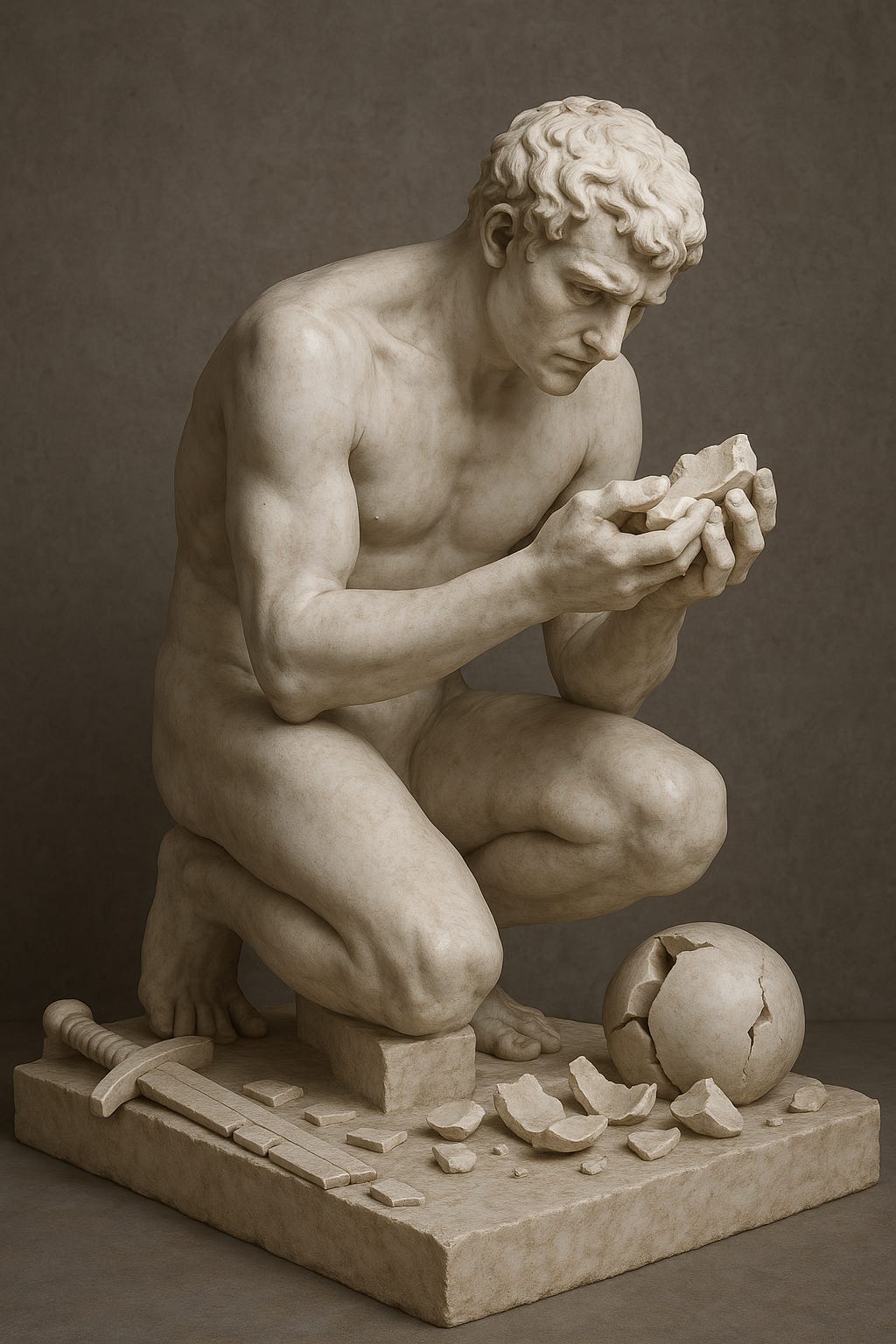
The statue reminded me of myself: a kid holding a broken egg with yolk dripping down his fingers. Thought I need to break something to understand it. But if the method destroys what we understand, then what’s the point of the method?
Mastery was never about pattern recognition. It was about relationships & principles.
Achieving mastery isn't about replicating the steps someone else took but being conscious of the steps you take. Each path reveals a new mastery.
Watch how a crowd behaves. We don't need cause a ruckus, stop everyone, and ask each person what they're doing and why. We watch and learn those reasons. Their relationships with the stores, where they go, and the people they're around. For mastery it's no different. How and what we observe creates the discoveries that no one else sees. That's what makes us masters.
The Wright Brothers proved this.
Hundreds of people studied human flight. They looked at their predecessors and followed the same path. But the Wright Brothers succeeded by following bicycle principles instead of aviation wisdom. They observed bicycles and birds and applied that knowledge to aviation. Their method revealed new mysteries and opened a path that pure study never could. If they studied what others had done & stuck to it, they wouldn't have gotten off the ground.
If we approach mastery like a cobblestone path, we'll arrive where everyone else has reached. But mastery is about where the path takes you. What you observe, where you go, the questions you ask & the method you use.
Focus on relationships, not just facts