
💡 Insights from Wes Kao
The Best Business Newsletter Online

Read time: 3.9 minutes
Welcome to Insight, my weekly newsletter where breakdown the world’s best writers & thinkers into frameworks you can use to build your writing skills.
The Story:
Wes Kao’s Newsletter is one of my favorite best business newsletters.
She has 15+ years of marketing & operations experience. She’s also co-founded Maven, an online course platform that’s helped 27,000+ students & instructors earn $18M. She also co-founded altMBA with Seth Godin going on to help leaders in 9 different countries succeed in their careers.
She has the business experience to fill volumes.
But even better is her writing style. It’s clear, concise, and well organized to the point of allowing anyone to skim the post and still come away with a good understanding.
Here’s how she does it:
2 Insights to improve your writing:
Insight 1) Headings:
Headings allow the reader to skim and find the information they want. But it also allows them to absorb information quickly.
Take her post on Be more assertive with customers.
Her headings follow an order:
Main topic of post.
Common fear related to topic.
Impact if you hold onto the fear.
Encouragement to overcoming the fear.
I created a post diving deeper into this if you’re curious:
Mohammad Khan on LinkedIn: What makes Wes Kao's Newsletter Awesome | 17 comments
www.linkedin.com/feed/update/urn:li:ugcPost:7210785429283835904
Insight 2) Structure:
Along with headings, she mixes in different structure styles depending upon the topic.
Structure 1) Open with a list for detailed posts:
In her posts WTF does it mean to “act like an owner”? & How to present to your CEO, she opens both with lists.
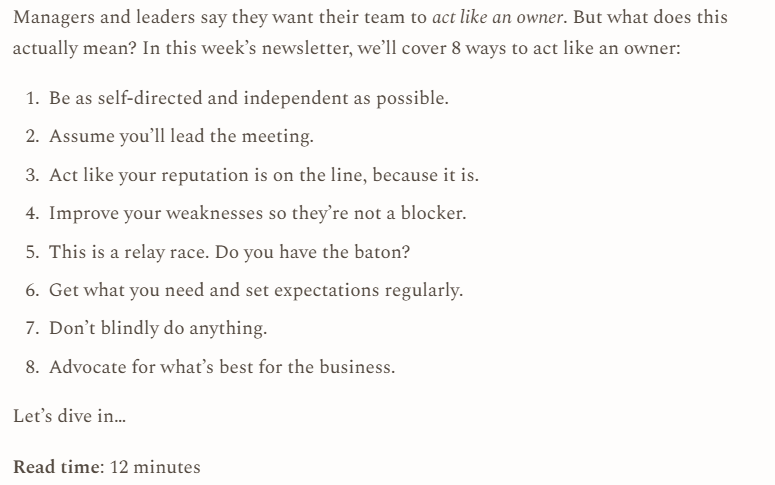
WTF does it mean to “act like an owner”?
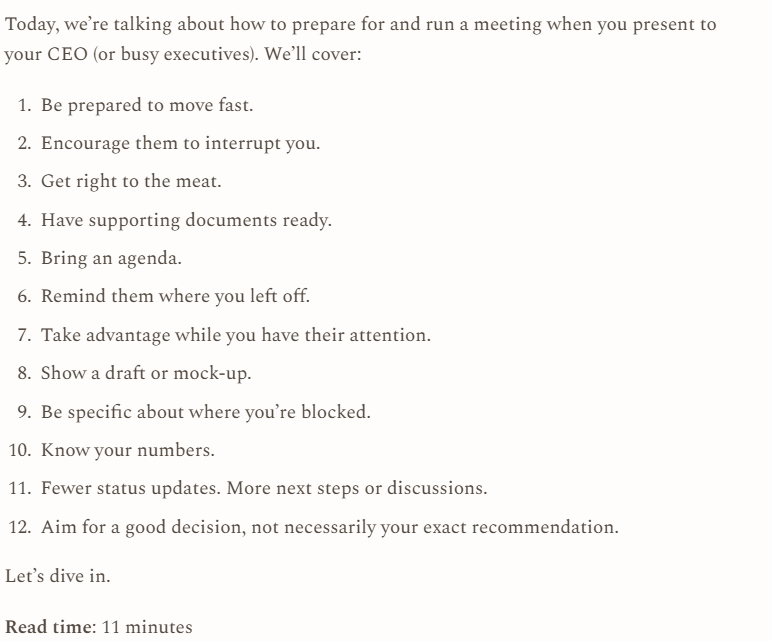
This is a great way to prompt your reader & help them sift through the info for what they want. It gives them a path to follow your thoughts.
Structure 2) Use Thesis-Antithesis-Synthesis for Spiky Points of View:
In her post on The Super Specific How: How to make your cohort-based course more rigorous, she uses this framework well.
Thesis (current state): Hierarchy of BS
Antithesis (opposite or what I’m proposing): Super Specific How
Synthesis (what’s a good mix of the two): Student Outcomes = North Star
This framework works well to break down an argument into logical steps the reader can follow.
The Application:
When writing long-form, readability and structure are important.
Use headings to help guide your reader down the page.
Don’t use generic titles but instead be specific. Use important ideas or takeaways as the heading to capture your reader’s attention.
If they like the takeaway, they’ll slow down and read the piece.
Using lists & the Thesis-Antithesis-Synthesis structure are great ways to organize your writing.
Open with lists when diving into a ton of information to help your reader stay on track.
Use Thesis-Antithesis-Synthesis framework when you’re arguing perspectives, positions, or ideals.
These two simple changes will improve your writing skills drastically.
If your reader doesn’t want to read your post because it’s poorly formatted and organized, then you might as well not have written anything.
That’s all folks!
See you next time.
—Mohammad Khan
PS: If you’re ready for more insights, here are other ways I can help: