
Let's talk Economics: An Introduction
No math or confusing graphs. Explained in Simple Language

Alright, change of pace this week.
Let’s talk Economics…. in simple language.
I’m going to avoid going into the Math & the charts because that’s just confusing and overwhelming.
At its core, Economics is the Science of People, Choices, given Limited Resources. That’s it.
Which means it applies to more than just finance & behavioral economics.
I’ll focus on these 3 points.
Intro to Economics
Common Terms & Economic Systems
1 Actionable Tip you can apply NOW.
Much of my research on Economics started with Crash Course & a few books:
Let’s break it down:
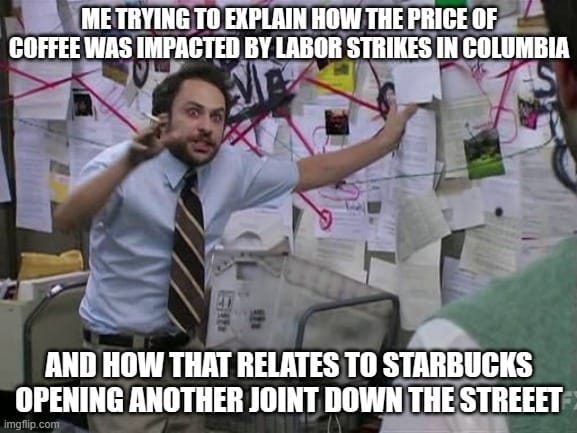
This newsletter in a meme:
WTF is Economics?
People call Economics the “dismal science” because too many people would result in food shortages and shortages of other resources.
But at its core, Economics is the Science of People + Choices given limited resources. Which means if we know our limits, we know where to change the system to incentivize different behavior.
There are many drivers to Economics but let’s focus on 2: Opportunity Cost & Scarcity.
Opportunity Cost is the cost of making any choice. It’s the loss of potential gain from other alternatives when one alternative is chosen.
Put Simply: Say you need to study for an exam, but your friends want to hang out. You can choose to hang out with friends but then you’d lose time spent studying for an exam. You can study for the exam and miss out on being with your friends.
You can’t do both…. yet or maybe ever? Who knows—Quantum Mechanics is weird.
Scarcity means limited resources. We don’t have unlimited resources so there are trade-offs. At an individual perspective, we don’t have unlimited time, money, or energy so we need to be conscious of how we use it.
Why do I need to understand Economics?
Economics is more than the graphs and equations. It’s about how you use available resources to survive.
Economics is a student choosing a career wondering about her future income in a changing job market. Economics is Google deciding how to develop phones and features to stay competitive. Economics is the government deciding between implementing fiscal policy to stabilize the economy.
Economics is a mixture of psychology + finance + math + systems thinking.
Understanding economics helps you analyze resources available —which can be time, money, energy, online resources — to reach a goal. It’s about who gets what & why.
If you’re interested in learning more on practical economics, I highly recommend: The Undercover Economist by Tim Harford
10 Common Terms + 3 Major Economic Systems:
Ok. We know why we need to understand economics, but what about the major terms people use? The Jargon used to keep you in the dark.
It’s like when investors use the terms “bull market”, “bear market”, “shorting”, “fire sale”, these terms have no meaning to someone outside.
Here are 10 of the Most Common Economic Terms:
Microeconomics: Studying individuals on how they make choices given scarcity
Macroeconomics: Study of the National Economy as a whole
Inflation: rise in prices of good we buy
Purchasing Power: The ability to purchase goods.
Gross Domestic Product: Total money value of all the completed goods and services that have been produced within a country’s borders in a set period of time.
Gross National Product: Estimate of the total value of all the final goods and services produced by a country’s residents.
Fiscal Policy: use of government spending and taxation, and its impacts on the economy
Monetary Policy: Controlling nation's overall money supply and achieve economic growth by revising interest rates and changing bank reserve requirements.
Monopoly: a market with a single seller or producer that excludes viable competition from providing the same product.
Oligopoly: a market with a small number of firms, none of which can keep the others from having significant influence.
3 Major Economic Systems:
You’ll hear these 3 economic systems the most. Capitalism, Socialism, Communism. What do they mean?
Capitalism:
A Capitalist system has private owner control property for their own interests. The driving motivation is profit.
People believe the United States to be a Capitalist Economy. It is not.
It’s a mixed economy of capitalist and socialist systems.
Socialism:
A socialist economic system is when workers or the government own the buildings and tools that make goods and services like farms and factories.
Think of public projects like bridges, roads, playgrounds. It is usually owned and operated by the government and paid for by a mix of taxation and user fees.
Communism:
As Karl Marx summarizes Communism in 1 sentence: Abolition of Private Property.
All property is publicly owned, and everyone is paid based on their ability and needs. Citizens share equally in economic resources as allocated by a democratically elected government.
Note: No country in history has ever been completely capitalist, socialist, or communist.
1 Actionable Tip: Greenspaces
From Tim Hartford’s Undercover Economist, Greenspaces are a way of artificially inflating prices by being in proximity of a desirable spot.
Here’s an example: You’re apartment hunting. You find a good spot near work, but the price is high. The reason is because apartments close to work centers are high value. No one likes a long commute. Prices go up. While apartments far away are priced low.
Where can you use this?
If you’re selling a product or marketing a service, position yourself associated with something/someone of higher value.
For example, if you’re selling an online course on LinkedIn, if you comment and promote it on other well-known online course creators adds more value to your course.
If you stand beside people who are higher up on the social ladder, by proximity you will be seen at the same level.
Greenspaces can also be used for controlling population sizes. Europe built Greenspaces around their cities because residents were complaining about the lack of trees. The Greenspaces not only increased home prices near the nature but also kept a cap on the population which led to an additional increase in home prices due to scarcity of space.
That’s all for today’s post. Thanks for reading my rant on economics!
If you want more on Economics or would like to me to break down other Complex Topics apart from Economics into simple language, Hit Reply & Let me know!
Also, let me know what you found most helpful this week—I’d love to hear from you!
See you next Saturday!
Mohammad Khan