
3 Steps to Create an Underdog Story (And Some news)
The Lean Startup Method in Action

The Big Idea:
The Lean Startup Method as an Underdog Story
Why the Framework Works as a Story
Breakdown the Framework
Use Case Examples
First the News:
I'll be taking a break from this for a while.
Got too much on my plate. Taking a step back and slowing things down to reprioritize. I have a bad habit of taking on too many projects at once.
I don’t know when the next one will be, but I hope you find these helpful.
Lean Startup Method as an Underdog Story
This is the classic underdog story.
The Lean Startup Method is an approach to product development and innovation that focuses on minimizing waste, maximizing learning, and quickly iterating based on feedback. It emphasizes an iterative approach to building and scaling products efficiently, reducing the risk of failure and increasing the chances of success.
Why it Works:
The Lean Startup Method is well-suited for engineering because it aligns with the principles of innovation, efficiency, and iterative development.
It allows engineers to test their assumptions, gather real-world feedback, and refine their solutions based on validated insights. By applying the Lean Startup Method, engineers can reduce the risk of developing products or solutions that do not meet market needs or perform as intended.
The method promotes a culture of continuous improvement and customer focus, enabling engineers to create innovative and impactful solutions efficiently.
Let’s break it down the framework:
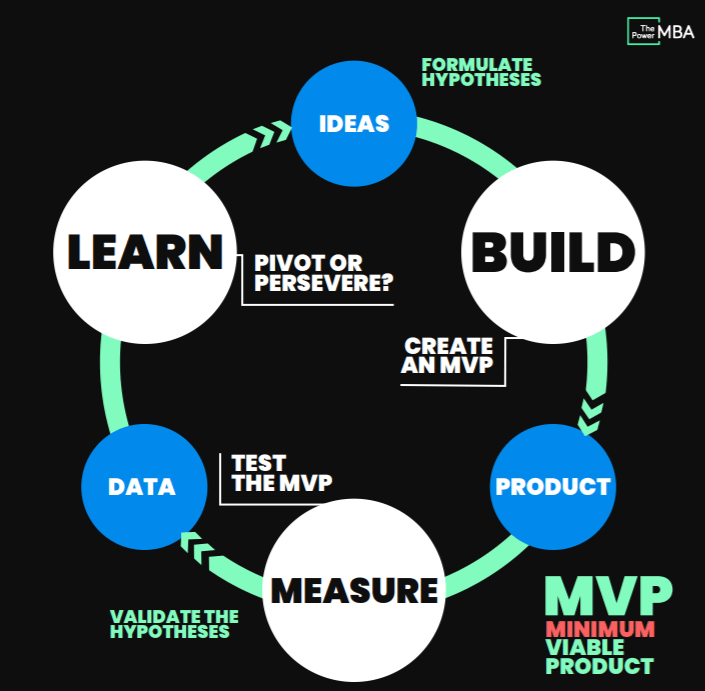
Lean Startup Methodology (2022) - The Power Business School
Start with a hypothesis: Begin by formulating a hypothesis about the problem you are trying to solve, the target market, and the proposed solution.
Build a minimum viable product (MVP): Develop a simplified version of the product or solution that allows you to test your hypothesis and gather feedback.
Measure and learn: Collect data and feedback from users and customers to validate or invalidate your hypothesis. Use this information to gain insight and make informed decisions.
Pivot or persevere: Based on the feedback and data, make adjustments to your product or strategy. Pivot if necessary, changing direction based on the insights gained, or persevere if the feedback confirms the viability of your hypothesis.
Repeat and iterate: Continuously repeat the cycle of building, measuring, and learning. Make incremental improvements and optimizations to your product based on the feedback and data gathered.
3 Benefits of the Lean Startup Method:
Benefit 1: Reduced risk: By validating assumptions and hypotheses early in the product development process, the Lean Startup Method helps mitigate the risk of building products that do not meet customer needs or market demand.
Benefit 2: Faster time to market: The iterative nature of the Lean Startup Method allows for faster development cycles, enabling products to be launched and refined more quickly.
Benefit 3: Increased customer focus: The method emphasizes gathering and incorporating feedback from customers and users, ensuring that the product aligns with their needs and preferences.
3 Reasons why the Lean Startup Method works:
Reason 1: Customer-centric approach: The method prioritizes understanding and addressing customer pain points, resulting in products that are more likely to meet market demand.
Reason 2: Continuous learning and improvement: By adopting an iterative approach and incorporating feedback, the Lean Startup Method promotes a culture of learning and improvement, leading to better products and solutions over time.
Reason 3: Efficient resource allocation: The method encourages the allocation of resources based on validated insights, minimizing waste and maximizing the impact of investments.
3 examples of the Lean Startup Method in use in Engineering:
Example 1: A civil engineering company develops a prototype construction material, tests it on a small-scale project, gathers feedback from contractors and builders, and iterates on the material's composition based on their input.
Example 2: An automotive engineering team designs a new vehicle feature, creates a prototype, conducts user tests to gauge usability and preferences, and makes adjustments to the design before finalizing the feature.
Example 3: A mechanical engineering firm develops a new manufacturing process, implements it on a pilot project, collects data on efficiency, quality, and cost-effectiveness, and iterates on the process to improve its effectiveness.

See you next Saturday!
If you’d like, here’s how you can support me:
Share this newsletter with a friend: Next-Level Engineer
Follow me on LinkedIn: https://www.linkedin.com/in/mohammadkhan1859/
If you’re in college or thinking of switching careers, download my FREE Career Decision Matrix: https://mohammadkhan135.gumroad.com/l/decision_matrix