
Back to Basics
And the allure of complexity

I work as an engineer.
Which means my days are stamped with 8–10-hour head-banging, hair-pulling, head-scratching issues. Most of which come from small mistakes. A misspelling in the code or an extra space in the configuration file which wrecks any program from reading it properly.
It’s fun working on complex projects and having the opportunity to build new technologies.
But there are points where I miss the simpler projects. When the systems weren’t interconnected, or I didn’t have to worry about budgets and funding. When I could build without worrying about intellectual property of an idea or selling the product.
Working on next generation technology is great but I forget the simple stuff.
Whenever I tutor at the local library for K-12 students, the hardest problems are the elementary & middle school ones. I know the high school physics, calculus, biology, history, sciences, and mathematics well, but the simpler stuff is hard. What’s the point of knowing how to do a derivative if I can’t solve a basic 8th grade math problem involving interest rates and growth?
The basics build the foundation.
Complexity has its place, but we shouldn’t forget the simple. As our devices become more integrated in our lives, we assume the more features and gizmos it has, the more useful it will be. That the future is about sleek designs, holographic tables, and every purpose tools shown in movies and tv shows.
But we always go back to the old and true method.
Despite Slack, Teams, and Discord, we still rely on email.
Despite minimalist design for cars and devices, we still crave tactile feedback.
Despite the use of AI for faster production, we still crave the slow, methodical tenderness of the human touch.
All future technology is built upon the basic items.
If we forget the foundation, then the buildings we build will crumble.
If you give an engineer a Lego set, coloring book, or anything that allows them to create, they will go crazy–more than most people.
Building a Lego set, and coloring go back to those simpler times. Carefree creation where the creator decides where to start and when to stop. Where the core of creation stemmed from curiosity, necessity, and passion. But for me, I didn’t have a Lego set or coloring book.
Instead, I had a roll of toilet paper and an idea.
I took 4 long strands of toilet paper and taped them to the blades of a ceiling fan. Turned the fan on and it formed a spiral around me.
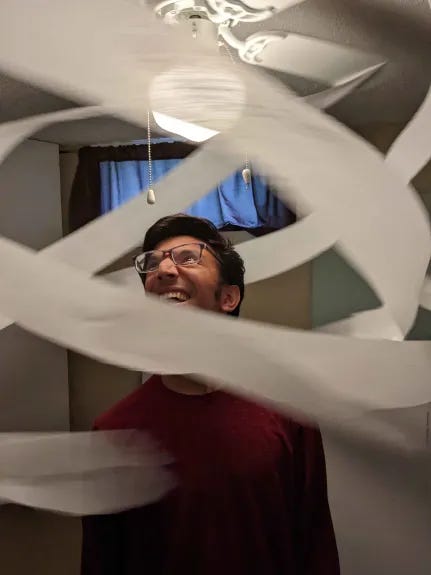
“It worked”, I cackled.
Well, of course it worked.
The point wasn’t to discover something new but to remember the simple foundation for engineering.
Play.
Going back to the roots of what each engineer has.
Complexity is fun to work on because of the interconnectedness of it all, like peering behind Oz’s curtain. But we forget complexity consists of simple rules repeated billions of times over. The simple decision of an ant breathes life into an ant colony just like simple lines of code breed complexity in larger systems.
Complexity is alluring but we shouldn’t forget the simple stuff.
Revisiting what makes who we are and gives us a reason for doing anything.
It’s the simple stuff that matters.
Good reminder. Thank you