
this shrimp is running to save a $70B industry

This week we’re talking about shrimp…running on a treadmill how the research could save a $70B industry
Hope you enjoy it!
—Mohammad Khan
read time: 9.5 min
The sun hasn’t broken the horizon yet, but the docks are alive.
Diesel engines cough awake as shrimpers prepare their gear and drive out for today’s catch. Their nets drag beneath the waves like tethered ghosts snatching up shrimp. Soon, the nets are winched up, lurching the boat to one side from its weight. The batch of shrimp glistens in the light, but something’s different on this catch.
Their gills are blackened like soot smeared on porcelain.
Black Gill disease.
It’s been haunting the waters on the Gulf Coast to the Chesapeake Bay since the 1990s. A parasite. Triggered by warming seas and stressed ecosystems, eating away at the local shrimp industry. Shrimp packing houses shutter, docks go quiet, and communities vanish.
The ocean gave us shrimp, now it also warns.
Black gill disease cut Georgia shrimp revenue in half, from $10M to $5.5M in a decade
In 2004, Georgia fisheries alone were worth a collective $10 million. By 2014, this value had dropped to $5.5 million. Black Gill disease alongside foreign imported shrimp devastated the local shrimping economy. The global shrimping industry limps along as similar diseases such as white spot syndrome in the East Asian waters spring up and spread due to warming waters, climate change, and intensive farming practices to obtain the highest yield per catch.
Black Gill disease isn’t harmful to humans, but it does kill shrimp. It reduces oxygen intake which slows shrimp down making them easy prey for predators which reduces the catch size shrimpers take home. The shrimp were dying faster and earlier than anticipated.
Shrimpers and fishery managers tried everything.
Broad chemical treatments to kill bacteria
Controlling temperatures
Improving water quality
They were trying to manage the problem downstream and prolong the shrimp’s life. At the time, there were no precise diagnostic studies done to see exactly how Black Gill disease spread and impacted a Shrimp’s physiology.
A $47 treadmill revealed how black gill suffocates shrimp under stress
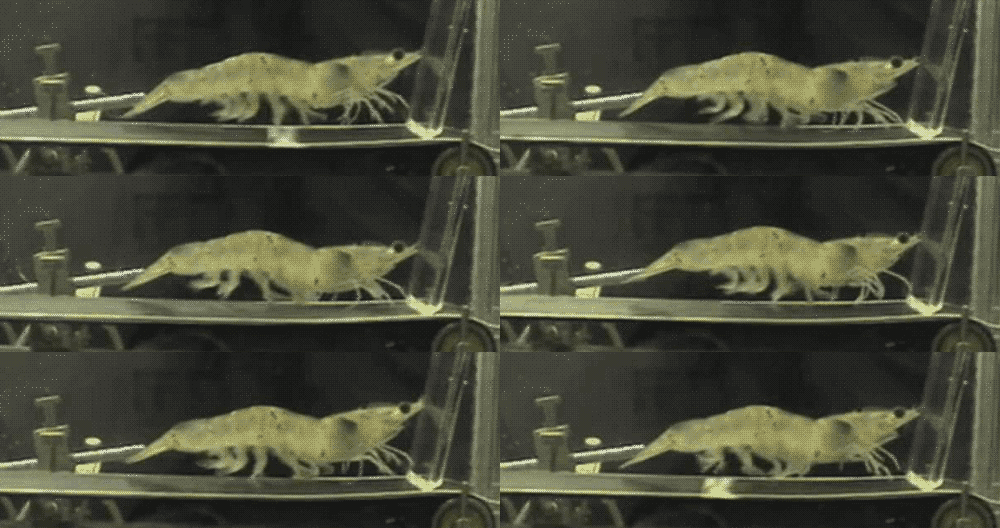
A shrimp on a treadmill (I named him Jacque), flapping his little legs for science.
In 2007, at a lab at the College of Charleston in South Carolina, Lou Burnett and his team built a treadmill for $47 to test how the shrimp physiologically responds under stress, infection, and low oxygen, trying to mimic conditions they face in warming, polluted waters. Running on a treadmill is similar to swimming against a current for a shrimp. The lab measured the oxygen uptake to study how Black Gill disease suffocates shrimp as they swim.
Shrimpers knew Black Gill disease impacted shrimp but didn’t know how.
It wasn’t until 2024, they published their findings on how Black Gill disease impacted the shrimp’s ability to uptake oxygen. They put a test group infected with Black Gill disease and a control group not infected in low oxygen water. The infected group had a significant drop in oxygen uptake when stressed only, not at rest. Meaning the shrimp could not move as well.
Now, pond managers and shrimpers could plan ahead to prolong the shrimp’s life when they find more Black Gill infected shrimp. They could move from “Black Gill is bad” to “Black gill + low oxygen + stress = more shrimp dying”. They could engineer the environment to have better oxygenated waters, lower water temperature, and moderate salinity.
The shrimp treadmill turned the black gill symptom into something measurable.
But after the famous video of a shrimp running on a treadmill spread online, the public didn’t see the science and the impact.
Headlines inflated the $47 to $700K. The public saw waste, not a $70B industry at risk
Once word got out that the government gave money to study shrimp on a treadmill, no one publicly liked it.
It’s hard to see the value of research when you’re struggling to put food on the table. The shrimp treadmill is the most recent example of research taken out of context.
The deeper problem is that we expect work to be obviously profitable. We’re conditioned by Silicon Valley and even small businesses that what we work on must lead to profit at some point.
If it doesn’t sell, it doesn’t matter.
But not all science research is immediately, or obviously, commercially viable. Most research builds foundation so that other for-profit companies can take it further into products and services.
This doesn’t mean the money was wasted, it means the market wasn’t ready yet.
GPS took 30 years to commercialize, Government funded what no company could justify.
In the 1970s, the Department of Defense developed GPS for missile guidance and troop coordination. It was expensive and reserved just for military use. In 1983, after Korean Air Lines Flight 007 was shot down after straying into Soviet airspace, Reagan opened GPS to civilian aviation to prevent future navigation tragedies. Navstar was allowed for commercial airplane use. Yet, Congress saw it as a pure military application, and the public saw the GPS receivers as clunky and expensive ($3000).
Most GPS use remained military until 2000 when Clinton GPS was opened for non-military use.
That opened the flood gates. GPS-infused phones, vehicles, and logistics systems entered the market. It transformed how people traveled, did business, and accessed information.
It took 20-30 years for foundational research to meet market application. If they made it public at the start, no for-profit company would’ve sunk money into it.
Research and development are expensive because there is no guaranteed ROI.
That’s why we still need science research even when it looks weird. Without baseline science research, there is no internet, iPhone, Ozempic, or ChatGPT.
The treadmill gave shrimpers variables to control, not a cure to buy
I know when it comes to ‘useless’ science, it’s easy to feel defensive (if you spent years on that research) and frustrated (if you’re the taxpayer funding it).
But we should focus on the positioning of the work.
The shrimp treadmill study didn’t give pond managers and shrimpers a product but instead gave them an equation they could control.
Stress + infection + low oxygen = shrimp death.
GPS gave us precise location data that cell phone, automobile, and logistics companies turned into route optimization.
If you’re positioning technical research, this is the reframe.
Don’t sell the idea. Sell the control mechanism that lets industries solve their own problems. That’s how ‘useless’ science becomes infrastructure.”
But most technical experts position infrastructure-stage research like it’s at product-stage. They pitch VCs when they should target SBIR grants. They say ‘breakthrough’ when they should say ‘risk mitigation.’ The timeline determines the strategy.
If you’re a researcher or technical expert, know which track your work is on.
Not all scientific research is immediately commercial. It might be foundational science. Stay aware of how these findings could be repositioned for commercial application.
If your research has no clear 5-year commercialization path:
Don’t pitch to VCs (they can’t wait 20 years)
Target SBIR/STTR grants explicitly designed for pre-commercial science
Lead with intended impact rather than methodology.
Don’t say ‘novel biomechanical analysis’ > say ‘risk mitigation for $70B industry.’ Don’t say ‘breakthrough innovation’ > say ‘infrastructure development for climate resilience.’Build partnerships with adjacent industries who benefit from baseline knowledge
If you’re a business, learn to spot when government-funded science is ripe for commercial applications.
Searching DARPA, SAM.gov, and NASA sites for patents for purchase is a good start. These are the moments when publicly funded knowledge is ready for commercialization.