
How Disease, Riots, and Affection can teach you about Online Growth
Understanding Online Growth through 3 Models


Scott E. Page’s “The Model Thinker” is a great resource to learn how to apply different scientific & mathematical models to life.
One thing to remember about using models: Every Model is Wrong.
Each model makes assumptions and cannot explain each aspect of life. But that doesn’t mean we don’t use them. Instead, we use 3-5 models to understand a phenomenon.
Think of it like seeing the world from 1 POV. Sure, you understand the world from that perspective but you’re blind to others. So, use multiple perspectives to understand the world.
Let’s understand Online Growth using these 3 models:
Preferential Attachment Model
Contagion Model
Riot Model
1) The Preferential Attachment Model:
To use this model, we assume a power law distribution.
Power law distribution: a small number of items is clustered at the top. An example: Few posts attract majority of the engagement while others get very little.
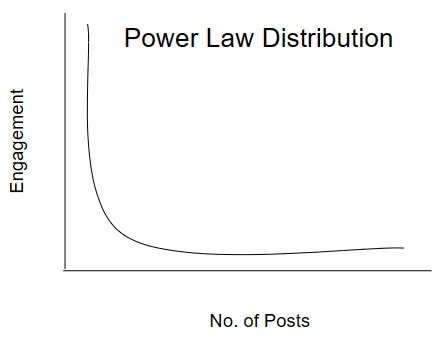
The preferential attachment model is what you think it means. People follow people who their friends or networks know.
In the context of online growth, to grow online:
Expand your network & DM people to increase the chance of people seeing your content.
2) Contagion Model:
The contagion model is used to model the spread disease, forest fires, and ideas.
An assumption to use this model is a fixed population to analyze.
To avoid diving deep into the math, we focus on 2 variables. Spread factor & Contact factor.
The Spread factor focuses on how many people share an idea.
The Contact factor focuses on people sharing the idea 1-on-1 with each other.
In the context of social media,
The spread factor is how many people share an idea.
Focus on making your posts what people want to see so they’ll share it more.
The contact factor is how often your idea grabs people’s attention.
Consistently post so people will see your posts more often.
So far, to Grow on social media according to the 2 models, do the following:
Preferential Attachment Model —> Grow your Network & DM people to increase your presence.
Contagion Model —> increase spread & contact factor of your posts through consistent posting & focusing your posts on what people want to read.
Let’s look at the Riot Model.
3) Threshold Riot Model:
The assumption for the riot model is that people have 2 choices: join or not join the riot. The person determines the threshold for joining a riot.
Without going into modeling human choices & agent-based models, we can focus on what causes people to join a riot.
People join a riot if many people are in the riot. If there are 100s of people in a riot, then someone is more to join than if there are 5. If you have a social proof + credibility through recommendations or testimonials, your follower count will increase. In the context of online growth, the riot is your following on social media.
To use the riot model to grow online:
Build a following so more people join you.
Demonstrate social proof/credibility in your posts to get more people to follow/subscribe to you through word-of-mouth.
For social media growth, do the following:
Preferential Attachment Model —> Grow your Network & DM people to increase your presence.
Contagion Model —> increase spread & contact factor of your posts through consistent posting & focusing your posts on what people want to read.
Riot Model —> social proof/credibility & building a following.
If you’re thinking, wait I already knew that. Congrats! Your brain does it automatically.
Now you have keywords to refine your internal model and grow faster.
Remember, each model on its own is wrong.
When you combine them, you gain a better understanding of the problem.